
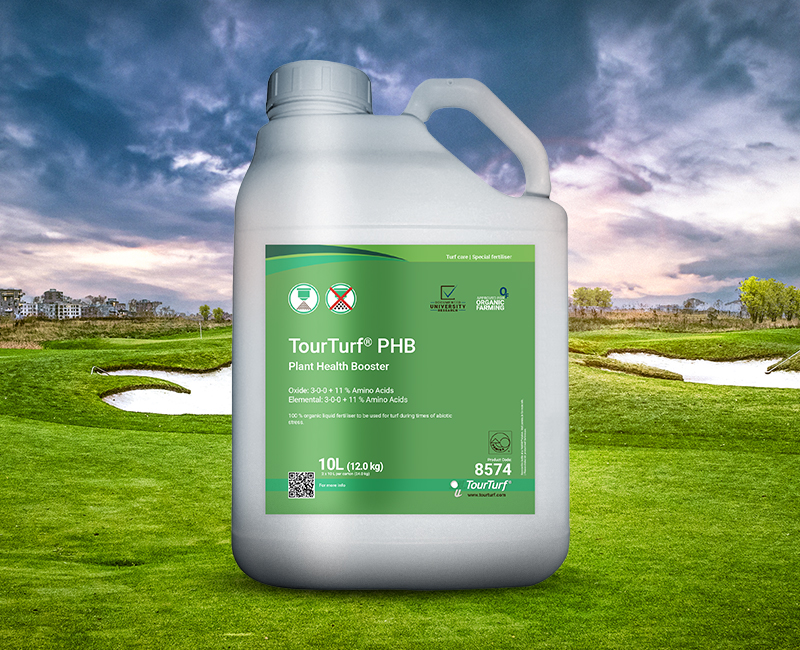
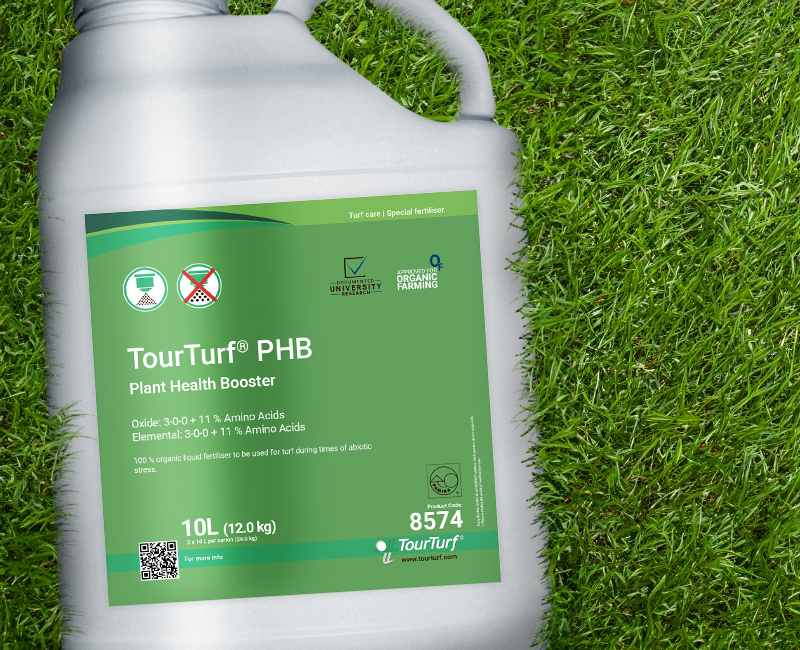
TourTurf® PHB Plant Health Booster 3-0-0 + 19% Amino Acids
_GB_Mockup_web.png)
_GB_Mockup_web.png&width=180&format=webp)
_GB_Mockup_web.png&width=640&format=webp)
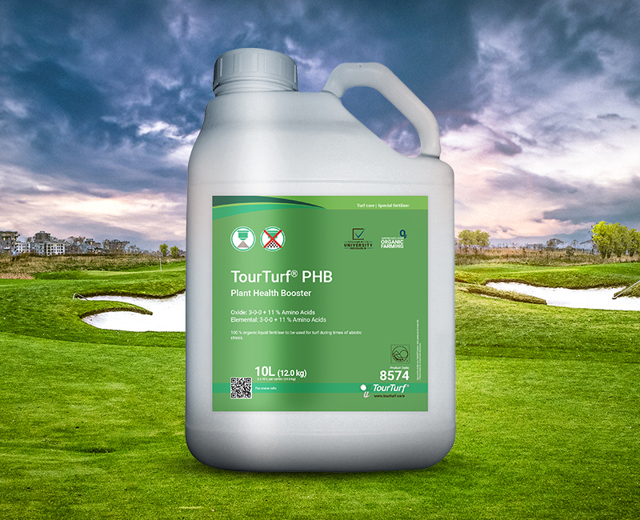
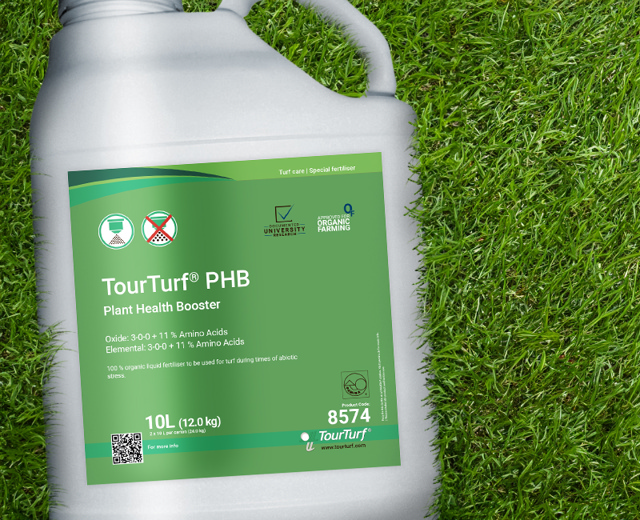
TourTurf® PHB Plant Health Booster is an organic liquid N fertiliser, designed to support turf plants with heat-, salt and drought stress relief and aid in recovery after Dollar spot, Fusarium disease, Gray leaf spot, nematode and insect damage. Apply this low pH product regularly to ensure efficient uptake of nutrients (NUE).
TourTurf® PHB contains 18 L-amino acids, peptides, fast-acting nitrogen and carbon, carefully balanced for rapid growth and greening. It also includes natural polysaccharides, osmolytes and phytohormones. Osmolytes help regulate osmotic pressure and support growth under stress. All amino acids and peptides come from non-GMO, plant-based raw materials sourced from the circular economy.
All the processes in the plant, like tissue development, growth, recovery from injury, and self-defense require proteins. The turf plant can normally produce all the needed amino acids from the mineral nutrients it takes in. During acute stress, the plant has no resources to make those bio-actives on its own. But the plant can instead absorb the ready-made amino acids from TourTurf® PHB, saving the energy to produce them itself.
This patented TourTurf® amino acid package, will give the plant all the stress relief it needs due to all the immediately available essential bioactive elements for maximum resiliency!
| Nitrogen (N) | 3 % |
| Amino acids | 19 % |
| Carbohydrates | 0.4 % |
| Carbon | 18.4 % |
| Organic material | 33 % |
| pH | 3 |
| Density | 1.2 |
| Content information |
* The L-Amino acids contains L-Glutamic acid, L-Threonine, L-Serine, L-Aspartic acid, L-Proline, L-Alanine, L-Valine, L-Methionine, L-Phenylanine, L-Glycine, L-Isoleucine, L-Leucine, L-Tyrosine, L-Lycine, L-Histidine, L-Arginine, L-Cystine & L-Tryptophan. The fatty acids contains: Stearic acid, Palmitic acid, Oleic acid, Linoleum acid & Linolenic acid. |
| Product name | TourTurf® PHB Plant Health Booster 3-0-0 + 19% Amino Acids |
| Product number | 8574 |
| CE labelled | Yes |
| HS code | 31010000 |
| Dangerous goods | No |
| Quantity per carton | 20 |
| Fertiliser type | Special |
| How to use |
2-4 week intervals all year around, when temperatures are above 5º C. |
| Application |
Plant stress relief: Disease recovery: Nematode & insect damage: |
| Nozzle size | Small droplets |
| Synergy | Synergy with OXT, TSF, TFC-series, MBP & FS-series. |
Downloads
| Name | Download | File type |
|---|---|---|
| PDS_ TourTurf® PHB Plant Health Booster _ 8574 GB.pdf | 3595 KB | |
| MSDS_TourTurf-PHB_Plant-Health-Booster_8574_GB.pdf | 158 KB |
Product details
Carbohydrates:
Carbohydrates serve as energy source for the soil microorganisms in order to increase microbial activity.
Carbon:
About 50% of a plant is made up of carbon, mostly synthesised from CO2 during photosynthesis. Carbon is the basis for all building blocks of life and essential for healthy soils.
- Increases the cation exchange capacity (CEC)
- Optimizes soil pH and salinity
- Improves water holding capacity
- Prevents nutrient leaching
- Improves soil structure for better air and water movement
- Higher microbial activity and soil biodiversity
- Makes nutrients more available
- Improved rooting for healthier, stronger plants
- Accelerates seed germination
Amino acids:
Amino acids are the building blocks for plant proteins. The plant will combine amino acids to form peptide chains and later complex proteins. All the processes in the plant like tissue development, growth, recovery from injury and self-defence require proteins.
The turf plant can synthesise all the needed amino acids from the mineral nutrients it takes in. But the plant can absorb amino acids through the roots as well, saving the energy to produce them itself, especially in times of plant stress.
Over time, microorganisms in the rootzone will break down amino acids into their components, making nutrients readily plant available.
The functions of the L-Amino Acids in PHB:
- L-Glutamic acid is a key compound in plant’s cellular metabolism. Glutamate also plays an important role in the disposal of excess or waste nitrogen.
- L-Threonine promotes normal growth by helping in the proper protein balance maintainance. Plays an important role in activating plant defense mechanisms.
- L-Serine plays important role in the catalytic function of many enzymatic reactions in plant tissues.
- L-Aspartic acid is needed for stamina, as well as gor the production of immunoglobulin and antibodies synthesis. Aspartic acid is essential in the process of chelating, or binding minerals, supporting their assimilation and utilization.
- L-Proline protects membranes and proteins against the adverse effects of toxic concentrations of inorganic ions and temperature extremes. Rapid catabolism of proline relieves plants stress and acts as precursor for chlorophyll synthesis.
- L-Alanine is the principal nitrogen secretion product in plant and has a crucial role in balancing their intracellular levels.
- L-Valine is a proteinogenic amino acid that the plant uses in the synthesis of proteins. It is one of the branched chain amino acids responsible for repairing and strengthening the muscular tissues.
- L-Methionine plays major role in sulfur transport in flowering plants. This amino acid is also used by plants for synthesis of ethylene. Ethylene is a natural plant hormone that promotes fruit ripening and leaf senescence.
- L-Phenylanine is a key biosynthetic enzyme that is mainly involved in defense mechanisms against plant diseases.
- L-Glycine The principal function of glycine is as a precursor to proteins. It is also a building block to numerous natural products that promote early flowering, alters stamen number and improves seed development.
- L-Isoleucine is a co-receptor complex that controls key aspects in plant growth, development and immune function. It aids plant repair mechanisms against insect attacks.
- L-Leucine promotes protein synthesis and retards the degradation of tissue by increasing the synthesis of tissue proteins in plants.
- L-Tyrosine activates specific protein receptors on the cell membrane. Aids photosynthesis.
- L-Lycine helps plant in producing metabolites which induce plant response to stress conditions and further plant development. Helps plants withstand high temperatures.
- L-Histidine promotes chelation, metal ions transport and stimulates plants reproductory and vegetative systems development.
- L-Arginine is an important and unique amino acid in plants. It serves not only as an important nitrogen reserve and recycling, but also as a precursor in the biosynthesis of polyamines, nitric oxide and others. Polyamines and nitric oxide are important messengers involved in almost all physiological and biochemical processes, growth and development, as well as in adaptation of plants to stress conditions.
- L-Cystine contributes to the synthesis of the tripeptide GSH which is necessary to reduce toxic effects
- L-Tryptophan is a unique amino acid bearing an indole ring contributing to the production of β-3-indolylalanine (IAA), an auxin that it is absorbed by plants and regulates various physiological and biochemical processes.




See some of our other products:
PROTECTING THE ENVIRONMENT IS VERY IMPORTANT.
SUSTAINABLE AND ORGANIC TURF CARE PRODUCTS
ARE FOR THE FUTURE.